

LEAD THE WAY
Continuing Ed
SPIRITUAL GIFTS, PROPHECY AND TONGUES
CONNECT
Connect through care, prayer and loving accountability for previous “I will …” statements
DISCOVER
Spiritual Gifts
1 Corinthians 12:1-31 (NIV)
1 Now about the gifts of the Spirit, brothers and sisters, I do not want you to be uninformed. 2 You know that when you were pagans, somehow or other you were influenced and led astray to mute idols. 3 Therefore I want you to know that no one who is speaking by the Spirit of God says, “Jesus be cursed,” and no one can say, “Jesus is Lord,” except by the Holy Spirit.
4 There are different kinds of gifts, but the same Spirit distributes them. 5 There are different kinds of service, but the same Lord. 6 There are different kinds of working, but in all of them and in everyone it is the same God at work.
7 Now to each one the manifestation of the Spirit is given for the common good. 8 To one there is given through the Spirit a message of wisdom, to another a message of knowledge by means of the same Spirit, 9 to another faith by the same Spirit, to another gifts of healing by that one Spirit, 10 to another miraculous powers, to another prophecy, to another distinguishing between spirits, to another speaking in different kinds of tongues, and to still another the interpretation of tongues. 11 All these are the work of one and the same Spirit, and he distributes them to each one, just as he determines.
12 Just as a body, though one, has many parts, but all its many parts form one body, so it is with Christ. 13 For we were all baptized by one Spirit so as to form one body—whether Jews or Gentiles, slave or free—and we were all given the one Spirit to drink. 14 Even so the body is not made up of one part but of many.
15 Now if the foot should say, “Because I am not a hand, I do not belong to the body,” it would not for that reason stop being part of the body. 16 And if the ear should say, “Because I am not an eye, I do not belong to the body,” it would not for that reason stop being part of the body. 17 If the whole body were an eye, where would the sense of hearing be? If the whole body were an ear, where would the sense of smell be? 18 But in fact God has placed the parts in the body, every one of them, just as he wanted them to be. 19 If they were all one part, where would the body be? 20 As it is, there are many parts, but one body.
21 The eye cannot say to the hand, “I don’t need you!” And the head cannot say to the feet, “I don’t need you!” 22 On the contrary, those parts of the body that seem to be weaker are indispensable, 23 and the parts that we think are less honorable we treat with special honor. And the parts that are unpresentable are treated with special modesty, 24 while our presentable parts need no special treatment. But God has put the body together, giving greater honor to the parts that lacked it, 25 so that there should be no division in the body, but that its parts should have equal concern for each other. 26 If one part suffers, every part suffers with it; if one part is honored, every part rejoices with it.
27 Now you are the body of Christ, and each one of you is a part of it. 28 And God has placed in the church first of all apostles, second prophets, third teachers, then miracles, then gifts of healing, of helping, of guidance, and of different kinds of tongues. 29 Are all apostles? Are all prophets? Are all teachers? Do all work miracles? 30 Do all have gifts of healing? Do all speak in tongues? Do all interpret? 31 Now eagerly desire the greater gifts.
Why does Paul use the image of a body to describe the church?
How are spiritual gifts to function within the body?
Why doesn’t the Spirit give all the gifts to one individual?
This is what MicroChurches can do best! Because we are small, everyone gets to play and use their gifts in ministering to the body. There’s no better way to discover and develop a spiritual gift than to use it in one another ministry.
Whatever you do as a leader, don’t try to function in all the gifts of the Spirit for your MicroChurch. The point is for the Body to use all their gifts for the building up of the Body. Your job as the leader is to give permission and facilitate this Body ministry.
Help your MicroChurch discover and develop their spiritual gifts. FOLLOW THE WAY - FILLING - Use It has a Discovery Bible Study on the spiritual gifts and an online Gifts Test.
Here are the definitions of the 22 spiritual gifts that make up the Gifts Test. (Adapted from the Gifts Test.)
Spiritual Gifts - Kingdom NOW Power Tools
DIFFERENT PERSPECTIVES
There are two main ways of looking at spiritual gifts.
1. Cessationism
Some Christians believe that the “miraculous” spiritual gifts have CEASED.
2. Continuationism
Others believe that all the spiritual gifts CONTINUE today.
Some continuationists exclude the office of Apostle, defining it as the unique authority given to the original apostles to write Scripture and lay the foundation of the church. Other continuationists believe that while this unique authority has ceased, apostolic-type ministry (pioneering, church planting, and leading new missional works) continues.
Who’s right? Have some gifts CEASED or do they CONTINUE?
While this debate involves several passages and theological arguments, much of the discussion centers around one word in 1 Corinthians 13: perfect.
Perfect?
Both sides often appeal to the same passage.
1 Corinthians 13:8-12 (ESV)
8 Love never ends. As for prophecies, they will pass away; as for tongues, they will cease; as for knowledge, it will pass away. 9 For we know in part and we prophesy in part, 10 but when the PERFECT comes, the partial will pass away. 11 When I was a child, I spoke like a child, I thought like a child, I reasoned like a child. When I became a man, I gave up childish ways. 12 For now we see in a mirror dimly, but then face to face. Now I know in part; then I shall know fully, even as I have been fully known (emphasis added).
Those who believe certain miraculous gifts have ceased often understand the perfect to refer to the completion of God's revelatory work through the apostles, now preserved in the New Testament Scriptures. In this view, gifts such as miracles, healings, prophecy, and tongues served a foundational role during the church's earliest years and were no longer needed once that foundation had been laid.
To be fair, cessationists differ among themselves, and some hold more nuanced positions regarding the continuation of certain gifts. Many believe that God still heals, guides, answers prayer, and works powerfully today, even while maintaining that the miraculous gifts are no longer normative for the church.
Those who believe that these gifts continue understand the perfect to refer to the return of Jesus Christ and the consummation of God's Kingdom. In this view, the gifts will remain available to the church until Christ returns and God's people experience the fullness of what is now only partial.
Which understanding best fits the passage?
Paul contrasts the now with the then.
Now we know in part. Then we shall know fully.
Now we see dimly. Then we shall see “face to face.”
What event marks the transition from the now to the then?
In our view, the passage points most naturally to the return of Christ rather than merely the completion of the New Testament. Even with the completed Scriptures, we still know only in part and do not yet see Jesus face to face. The language Paul uses appears to describe a future fulfillment that has not yet arrived.
Furthermore, the New Testament consistently presents spiritual gifts as tools for strengthening, encouraging, guiding, and building up the church. The church today faces the same mission, the same spiritual battles, and the same need for God's empowering presence as the early church. For that reason, we believe the gifts of the Spirit remain available and valuable until Jesus returns.
DIFFERENT PERSPECTIVES WITHIN CONTINUATIONISM
There are two common ways continuationists understand how spiritual gifts function.
1. Constitutional Gifts
Some continuationists believe that God gives particular gifts to believers that remain throughout most or all of their lives. These are often called constitutional gifts because they characterize how the Spirit regularly works through a person.
Romans 12:6-8 (NIV)
6 We HAVE different gifts, according to the grace given to each of us. If your gift is prophesying, then prophesy in accordance with your faith; 7 if it is serving, then serve; if it is teaching, then teach; 8 if it is to encourage, then give encouragement; if it is giving, then give generously; if it is to lead, do it diligently; if it is to show mercy, do it cheerfully (emphasis added).
According to this view, each believer has a gift or gifts that the Spirit consistently uses in their life and ministry.
2. Constitutional and Situational Gifts
Other continuationists affirm constitutional gifts while also recognizing situational gifts.
According to this view, the Holy Spirit is sovereign over the distribution of gifts at all times—not only when a person first comes to faith. Depending on the need and the believer's willingness to respond, the Spirit may empower anyone with whatever gift is needed for a particular moment of ministry.
In other words, the Spirit may invite a believer into a ministry opportunity and provide exactly what is needed in that moment:
"I want to minister through you right now, and here is the gift needed for this situation."
According to this view, believers may have constitutional gifts that regularly characterize their ministry, while also receiving situational empowerments as the Spirit wills.
This is the position embraced by the Vineyard and by The Way.
OUR POSITION
THE GIFT Is the Holy Spirit
Acts 1:4-5 (NIV)
4 On one occasion, while he was eating with them, he gave them this command: “Do not leave Jerusalem, but wait for THE GIFT my Father promised, which you have heard me speak about. 5 For John baptized with water, but in a few days you will be baptized with the Holy Spirit” (emphasis added).
As important as spiritual gifts are, they are secondary to our relationship with the Holy Spirit Himself. He is THE GIFT of the Father. Spiritual gifts are expressions of His presence and power working through believers.
So as Paul says, eagerly desire spiritual gifts (1 Corinthians 14:1). But above all, pursue a deeper relationship with the Holy Spirit.
For a deeper dive into our relationship with the Holy Spirit, see THE HOLY SPIRIT: With, In, and ON.
Spiritual Power Tools
Spiritual gifts are different from natural talents. Natural talents, though ultimately given to us by God, operate through human ability, personality, training, wisdom, and experience. Spiritual gifts, on the other hand, are empowered by the Holy Spirit.
For example, consider discernment. Human discernment, based on wisdom and experience, can cut through lies and deception. But the spiritual gift of discernment comes with Spirit-given insight, understanding, and conviction.
The same is true for many other talents and spiritual gifts. Human leadership, teaching, administration, encouragement, and service are all valuable. But the spiritual gifts of leadership, teaching, administration, encouragement, and service take these abilities to another level—a level of Spirit-empowerment.
Natural talents, then, are like hand tools—valuable and useful. But spiritual gifts are power tools—empowered by the Holy Spirit.
Can the Holy Spirit elevate a natural talent into a spiritual gift? Certainly. Can the Spirit also empower someone in ways that are completely different from their natural talents and abilities? Absolutely. The Holy Spirit is sovereign over the distribution of gifts (1 Corinthians 12:11).
Scripture also reminds us that spiritual power does not always come from God. There are counterfeit signs and works empowered by demonic forces (Revelation 13:11–15; 16:13–14).
Ultimately, it comes down to the source of power. Natural talents operate through human ability. The gifts of the Spirit are empowered by the Holy Spirit. And counterfeit spiritual works are empowered by demonic forces.
Kingdom NOW Power Tools
The gift of the Spirit—and the gifts of the Spirit—are signs that the “last days” promised by Joel and announced by Peter in Acts 2 have begun. The age to come has broken into the present. The Spirit’s presence makes the future Kingdom present in our lives. The Spirit’s power brings the reality of God’s Kingdom into the here and now.
We acknowledge that there remains an Already but Not Yet to God’s Kingdom. The Kingdom is truly here, but not yet fully here. The gifts of the Spirit, then, help the church express and experience the reality of God’s Kingdom here and now while awaiting its complete fulfillment when Christ returns.
The gifts of the Spirit are Kingdom NOW power tools.
The Church Continues the Ministry of Jesus
In Paul’s teaching on spiritual gifts, he describes the church as the Body of Christ (1 Corinthians 12:27).
Paul’s point is clear: through the various gifts of the Spirit, the church continues the visible and tangible ministry of Jesus in the world.
Through these Kingdom NOW power tools, the Spirit uses the church to advance the Kingdom of God and push back the kingdom of darkness.
The gift of leadership calls the church to action.
The gift of discernment recognizes where spiritual battle is taking place.
The gift of administration mobilizes the mission.
The gifts of healing, mercy, pastoring, and teaching help set captives free and restore people to wholeness.
Spiritual Gifts Are HOW the Spirit Works Through People
Spiritual gifts are descriptions of HOW the Holy Spirit works through people.
The Spirit does not simply give someone a spiritual gift and then step away, leaving them to operate independently. A spiritual gift is the ongoing presence and power of the Spirit working through a believer.
For example, the gift of teaching is the Holy Spirit empowering someone to teach effectively for the building up of others.
A spiritual gift, then, is not merely a thing or possession. It is the active ministry of the Holy Spirit expressed through a person.
This means we are not called merely to grow in the use of our gifts, but to grow in our relationship with the Holy Spirit Himself. After all, HE IS THE GIFT.
Think of a spiritual gift like a corded power tool. It only works when plugged in.
Constitutional AND Situational Gifts
Some gifts appear to function constitutionally—that is, regularly and even permanently. Certain believers consistently teach, lead, shepherd, encourage, or evangelize because this is how the Holy Spirit regularly works through them over the course of their lives. These become their spiritual specialties and primary areas of ministry effectiveness.
At the same time, any gift may be given situationally. The Holy Spirit remains sovereign over the distribution of gifts and may empower any believer with any gift at any time for a specific moment of ministry.
What can hinder this? Our unwillingness to participate.
We should never say:
“I can’t do that. That’s not my gift.”
While believers may have constitutional gifts, no follower of Jesus should assume that God cannot work through them beyond those areas. The same Spirit who regularly empowers us in certain ways is also able to empower us in unexpected ways whenever He chooses.
Our responsibility is not to determine what God can do through us, but to remain available whenever He chooses to work through us.
So rather than saying, “That’s not my gift,” our posture should be:
“Here I am, Lord. Use me.”
Everyone Gets to Play
The Bible’s teaching on spiritual gifts makes one thing clear: Everyone gets to play.
Every believer receives gifts for a lifetime of ministry, and any believer may be empowered with situational gifts as the Spirit wills. No one is meant to remain on the sidelines. So get off the bench and into the game.
Spiritual gifts are never grounds for superiority, status, or spiritual elitism. Gifts are given to serve others, strengthen the church, and reveal the love and power of Jesus.
Therefore, rather than looking to one gifted person to do all the ministry, a healthy and mature Body equips and mobilizes every believer to participate in ministry through the gifts of the Spirit.
Gifts AND Fruit
Sandwiched between the two chapters on the gifts of the Spirit is Paul’s great chapter on love.
1 Corinthians 12:13
Now eagerly desire the greater gifts. And yet I will show you the most excellent way.
1 Corinthians 13:1-3, 13 (NIV)
1 If I speak in the tongues of men or of angels, but do not have love, I am only a resounding gong or a clanging cymbal. 2 If I have the gift of prophecy and can fathom all mysteries and all knowledge, and if I have a faith that can move mountains, but do not have love, I am nothing. 3 If I give all I possess to the poor and give over my body to hardship that I may boast, but do not have love, I gain nothing.
13 And now these three remain: faith, hope and love. But the greatest of these is love.
1 Corinthians 14:1 (NIV)
Follow the way of love and eagerly desire gifts of the Spirit, especially prophecy.
The gifts of the Spirit are great, but the fruit of the Spirit, especially love is even better. So much so that Paul says you if you have gifts without love, you have nothing at all.

You can think of the gifts of the Spirit and the fruit of the Spirit like the two rails of a railroad track. Both rails must run together for the train to move forward.
If the fruit rail stops short, our lives derail because the fruit of the Spirit—especially love—is missing. We may be gifted, but without love those gifts become hollow.
If the gift rail stops short, our lives derail in the other direction. We may have love and good character, but the Kingdom NOW power tools of the Spirit are missing.
Healthy disciples grow in both the character of the Spirit within and the power of the Spirit upon. So make sure both rails are maturing in your life.
See THE HOLY SPIRIT: With, In, and On.
Practice Makes Progress
Spiritual gifts are graciously given by the Holy Spirit, but they are not always fully developed the moment they are received. Just as natural abilities grow through practice and experience, spiritual gifts often mature as they are exercised in faithful obedience.
The Spirit is the source of the gift and the power behind it. A gift of healing, for example, can bring genuine healing because God is at work. Yet as a believer continues to step out in faith, they often grow in wisdom, discernment, confidence, and effectiveness in using that gift. The gift itself is given by grace, but our ability to steward that gift well develops over time.
Does a spiritual gift bring additional power and effectiveness to ministry? Yes. Can a believer grow in the wise and effective use of that gift? Yes. The Spirit empowers, and faithful practice brings maturity.
Roles, Gifts, and Ministries
It is helpful to distinguish between roles, gifts, and ministries.
For example, every believer has the role and responsibility of being a witness for Jesus. You do not need a special spiritual gift to share your faith, shine your light, and tell people about Jesus. As you do, the Holy Spirit works through your witness.
Some believers are additionally given the gift of evangelism. Whether permanent or situational, this gifting brings unusual effectiveness, clarity, boldness, or impact in helping people come to Christ.
Others are called into the ministry of evangelism. Their spiritual gifting becomes a primary area of leadership and service within the church. Even then, evangelists are not called to do all the evangelism themselves. Their role includes equipping the whole church to become effective witnesses.
Ephesians 4:11-13 (NIV)
11 So Christ himself gave the apostles, the prophets, the EVANGELISTS, the pastors and teachers, 12 to equip his people for works of service, so that the body of Christ may be built up. 13 until we all reach unity in the faith and in the knowledge of the Son of God and become mature, attaining to the whole measure of the fullness of Christ (emphasis added).
A spiritual gift, then, is a Spirit-empowered ability joined to a Spirit-directed calling. It is our Spirit-enabled ministry expression.
The Mark(s) of a Spirit-Empowered Believer
The Way believes that all the spiritual gifts are available and valuable today. However, we do not believe that the gift of tongues is the mark of a Spirit-empowered Christian.
In the New Testament, the gift of tongues often accompanied the empowering of the Holy Spirit—but not in every case. Paul even said, “I would like every one of you to speak in tongues” (1 Corinthians 14:5), yet this falls short of saying that everyone will speak in tongues. In fact, Paul rhetorically asks, “Do all speak in tongues?” (1 Corinthians 12:30), with the implied answer being no.
Therefore, while the gift of tongues is still available and valuable today, it is not the defining mark of a Spirit-empowered believer.
Instead, the Spirit-empowered Christian is characterized by power to be a witness for Jesus (Acts 1:8), along with whatever gifts the Spirit chooses to give—whether permanently or situationally for particular moments of ministry (1 Corinthians 12:1–11, 27–31). And all the gifts of the Spirit must be exercised and expressed in a manner shaped by the fruit of the Spirit, especially love (1 Corinthians 13).
So power for witnessing, along with the gifts of the Spirit and the fruit of the Spirit, are the marks of a Spirit-empowered believer. Of course, we are free to desire and ask God for the gift of tongues. We simply do not require it.
Gifts Require Humility and Discernment
Because spiritual gifts involve real people responding to the Holy Spirit, humility and discernment are essential. Spiritual gifts should always function in love, remain grounded in Scripture, and be exercised within healthy Christian community.
No believer is infallible, and spiritual impressions, prophetic words, or ministry experiences should be tested with wisdom and discernment. The gifts of the Spirit are never meant to control, manipulate, or elevate one person above others. Instead, they are given to serve people, strengthen the church, and point others to Jesus.
The healthiest environments are those where believers eagerly pursue the gifts of the Spirit while remaining deeply humble, teachable, and accountable.
Practicing for Real Life
Finally, what we practice in community, we carry into everyday life.
As spiritual gifts are discovered and developed in our MicroChurches, they are then mobilized missionally throughout our homes, workplaces, neighborhoods, schools, and circles of influence.
Spiritual gifts, then, not only equip us for ministry to one another within the church, they also mobilize us for Kingdom ministry in the world.
Lead Your MicroChurch
Help your MicroChurch discover and develop their spiritual gifts. Follow The Way - FILLING - Use It has a Discovery Bible Study on the spiritual gifts and an online Gifts Test.
DEFINITIONS OF GIFTS printable PDF.
Which leads naturally to the laying on of hands…
Laying On of Hands
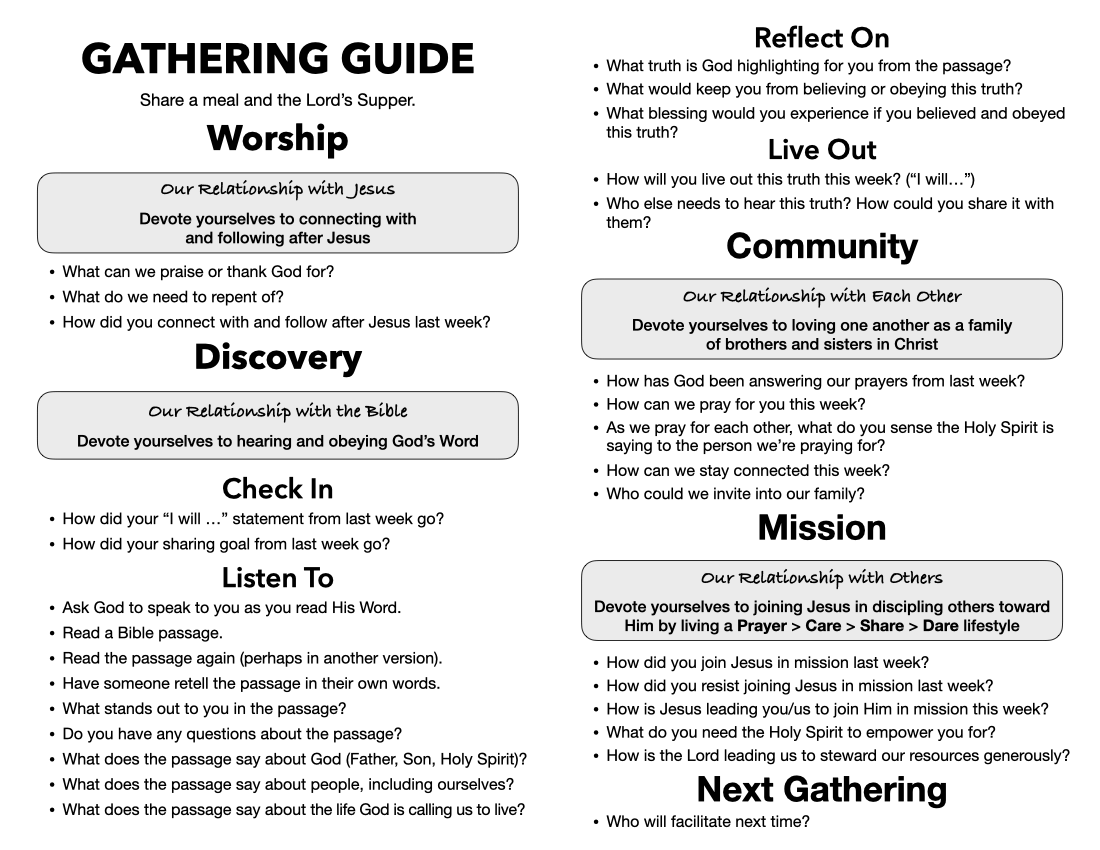
Regularly lay hands on each other and pray for empowering of the Holy Spirit and the activation of spiritual gifts. (See THE HOLY SPIRIT AND HIS GIFTS in The Way’s Theological Distinctives.)
Pray that the Holy Spirit would come upon you to empower you to live and witness for Jesus boldly.
That’s why the Gathering Guide for The Way MicroChurches includes this question:
What do you need the Holy Spirit to empower you for?
Guidelines for Prophecy
God speaks primarily through His Word—the Bible. So if you want a word from the Lord, read your Bible.
But as you read your Bible, you will discover that God also speaks to us by His Spirit through a still, small voice, dreams and visions, angels, and the gifts of prophecy, tongues, and interpretation. So how can we grow in practicing and testing prophetic words? Let’s take a look.
Acts 2:17-18 quoting Joel 2:28-29 (NIV)
17 In the last days, God says,
I will pour out my Spirit on all people.
Your sons and daughters will prophesy,
your young men will see visions,
your old men will dream dreams.
18 Even on my servants, both men and women,
I will pour out my Spirit in those days,
and they will prophesy.1 Corinthians 14:1-3
1 Pursue love, and earnestly desire the spiritual gifts, especially that you may prophesy. 2 For one who speaks in a tongue speaks not to people but to God; for no one understands him, but he utters mysteries in the Spirit. 3 On the other hand, the one who prophesies speaks to people for their upbuilding, encouragement and comfort.
1 Corinthians 14:26
What should you do then, brothers and sisters? When you come together, each one has a song, has a lesson, has a revelation, has a tongue, has an interpretation. Let all these be done to build each other up.
1 Corinthians 14:29 (NLT)
Let two or three people prophesy, and let the others evaluate what is said.
1 Thessalonians 5:19-22 (NIV-1984)
19 Do not put out the Spirit's fire; 20 do not treat prophecies with contempt. 21 Test everything. Hold on to the good. 22 Avoid every kind of evil.
Practicing the Prophetic
Take turns focusing on one person. Ask the Lord how He would build up, encourage, and comfort them (1 Corinthians 14:3). This question may help you get started: “What do you sense the Holy Spirit is saying to the person we’re praying for?” Then sit quietly and listen. You may receive a thought, picture, passage, or even a physical sensation (such as pain in your body).
When sharing, avoid overly authoritative language like “Thus says the Lord.” Instead, offer impressions humbly and invite discernment. For example: “I had a thought/picture/passage/pain that might be from the Lord. Does this resonate with you? What do the rest of you think?”
If nothing comes, that’s okay—prayerful listening is part of learning. Don’t force it. Remember, faith is spelled T-R-Y.
If something comes to mind, share it—not to impress others, but to love well and build others up.
When something is shared, it’s important to test it. As a leader, be an equal-opportunity tester—you can’t invite discernment for one person’s word and not another’s. It’s wise to lead your community in weighing all impressions together.
Some words carry more weight than others. Simple encouragements can be received and briefly assessed, but words that give direction or call for significant life change require careful and prayerful testing.
How?
Testing the Prophetic
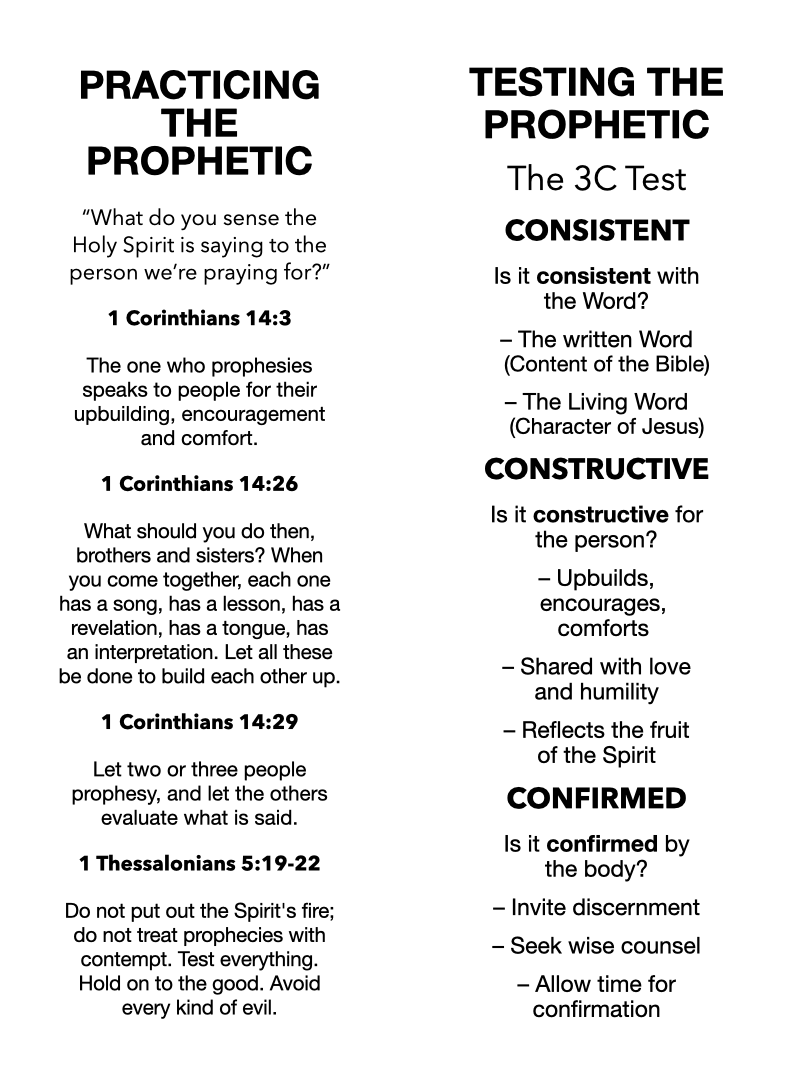
Use this 3C Test for prophetic words, interpretations of tongues, or any leading you sense from the Spirit.
1. Consistent
Is this “word” consistent with the Word?
The Written Word — the Bible
A prophetic impression doesn’t need to quote a verse directly, but it must align with the overall teaching and character of Scripture. Any word that doesn’t pass this test must be rejected.
The Living Word — Jesus Christ
Is this something Jesus would say—and would He say it this way?
2. Constructive
Is this “word” constructive for the person?
Upbuilding
Prophetic words are given for the upbuilding, encouragement and comfort of others (1 Corinthians 14:3). In other words, the purpose of prophecy is to strengthen people.
This doesn’t mean the Spirit won’t give a word of correction to you or through you for someone else. But such words must be handled with great care. Satan condemns; the Spirit lovingly convicts. So be sure to share correction in a constructive way—building up, not tearing down.
If you’re unsure how to share a corrective word, confidentially seek wisdom from a trusted brother or sister.
The Fruit of the Spirit
Do you see the fruit of the Spirit in both the content of this word and the manner in which it is shared?
3. Confirmed
Is this “word” confirmed by the body?
Testing
Invite others to help discern whether a prophetic word is from the Lord. Especially when a word involves significant decisions or life changes, seek wisdom from mature believers and allow time for confirmation.
Testing a word isn’t unbelief—it’s obedience. God commands us to let others evaluate what is said (1 Corinthians 14:29) and to test everything (1 Thessalonians 5:21).
Quoting Deuteronomy 19:15, Paul writes: On the testimony of two or three witnesses every matter shall be confirmed (2 Corinthians 13:1).
Receiving and Rejecting
If a prophetic word is confirmed, you can move forward with confidence. If it is not confirmed, hold it loosely and wait—confirmation may come.
Conclusion
If a “word” proves consistent with God’s Word, constructive for the person, and confirmed by the body, you can be confident it is from the Lord. If it doesn’t pass these tests, you can be sure it is not.
Practicing and Testing the Prophetic Bookmark
Guidelines for Tongues
1 Corinthians 12:27-30 (NIV)
27 Now you are the body of Christ, and each one of you is a part of it. 28 And God has placed in the church first of all apostles, second prophets, third teachers, then miracles, then gifts of healing, of helping, of guidance, and of different kinds of tongues. 29 Are all apostles? Are all prophets? Are all teachers? Do all work miracles? 30 Do all have gifts of healing? Do all speak in tongues? Do all interpret? 31 Now eagerly desire the greater gifts.
1 Corinthians 14:1-5
1 Pursue love, and earnestly desire the spiritual gifts, especially that you may prophesy. 2 For one who speaks in a tongue speaks not to people but to God; for no one understands him, but he utters mysteries in the Spirit. 3 On the other hand, the one who prophesies speaks to people for their upbuilding, encouragement and comfort. 4 The one who speaks in a tongue builds up himself, but the one who prophesies builds up the church. 5 Now I want you all to speak in tongues, but even more to prophesy. The one who prophesies is greater than the one who speaks in tongues, unless someone interprets, so that the church may be built up.
1 Corinthians 14:12-19
12 So it is with you. Since you are eager for gifts of the Spirit, try to excel in those that build up the church.
13 Therefore, one who speaks in a tongue should pray that he may interpret. 14 For if I pray in a tongue, my spirit prays but my mind is unfruitful. 15 What am I to do? I will pray with my spirit, but I will pray with my mind also; I will sing praise with my spirit, but I will sing with my mind also. 16 Otherwise, if you give thanks with your spirit, how can anyone in the position of an outsider say “Amen” to your thanksgiving when he does not know what you are saying? 17 For you may be giving thanks well enough, but the other person is not being built up. 18 I thank God that I speak in tongues more than all of you. 19 Nevertheless, in church I would rather speak five words with my mind in order to instruct others, than ten thousand words in a tongue.
1 Corinthians 14:26-33
26 What should you do then, brothers and sisters? When you come together, each one has a song, has a lesson, has a revelation, has a tongue, has an interpretation. Let all these be done to build each other up. 27 If anyone speaks in a tongue, two—or at the most three—should speak, one at a time, and someone must interpret. 28 If there is no interpreter, the speaker should keep quiet in the church and speak to himself and to God.
29 Let two or three people prophesy, and let the others evaluate what is said. 30 And if a revelation comes to someone who is sitting down, the first speaker should stop. 31 For you can all prophesy in turn so that everyone may be instructed and encouraged. 32 The spirits of prophets are subject to the control of prophets. 33 For God is not a God of disorder but of peace, as in all the gatherings of God’s holy people.
Once again, The Way believes that all the spiritual gifts are available and valuable for today. However, we do not believe that the gift of tongues is the mark of a Spirit-empowered Christian.
In the New Testament, the gift of tongues often accompanied the empowering of the Holy Spirit—but not in every case. Paul even said, “I would like every one of you to speak in tongues” (1 Corinthians 14:5), yet this falls short of saying that everyone will speak in tongues. In fact, Paul rhetorically asks, “Do all speak in tongues?” (1 Corinthians 12:30), with the implied answer being no.
Therefore, while the gift of tongues is still available and valuable today, it is not the defining mark of a Spirit-empowered believer.
Instead, the Spirit-empowered Christian is characterized by power to be a witness for Jesus (Acts 1:8), along with whatever gifts the Spirit chooses to give—whether permanently or situationally for particular moments of ministry (1 Corinthians 12:1–11, 27–31). And all the gifts of the Spirit must be exercised and expressed in a manner shaped by the fruit of the Spirit, especially love (1 Corinthians 13).
So power for witnessing, along with the gifts of the Spirit and the fruit of the Spirit, are the marks of a Spirit-empowered believer. Of course, we are free to desire and ask God for the gift of tongues. We simply do not require it.
Once again, we need to make a distinction between speaking in tongues and praying or singing in tongues. When a tongue is spoken in the context of a MicroChurch that needs an interpretation. Praying and singing in tongues doesn’t necessarily need an interpretation.
If you are discussing tongues, feel free to ask someone to give a demonstration. Some people may never have heard a tongue. If you are demonstrating the gift that doesn’t necessarily need an interpretation.
You can certainly pray for the gift of tongues and you can pray over those who wish to receive this gift. And it’s okay to explore and experiment with this gift. For example, since the gift of tongues is in control of the person with the gift (it's not out of control ecstatic utterance), when someone is seeking the gift they may need to try it on for size. In other words, they may need to open their mouth and try saying something. If something comes and continues, that’s probably the gift. If something comes but doesn’t continue, well, maybe not. Once again, it’s okay to explore and experiment. And why can’t we ask for this gift more than once? Just don’t manipulate or manufacture it. And never make anyone feel second class for not speaking in tongues, including yourself. The gift of tongues is just one of the many good gifts the Spirit gives as He wills. We need to celebrate any and every gift the Spirit gives.
If a tongue in prayer or song is heard by the group, that doesn’t necessarily need an interpretation. However, it might be best for that person moving forward to pray or sing in their tongue silently or under their breath. The point is you don’t want the gift of tongues in prayer and song to call attention to itself.
There may be times when you ask everyone to pray and praise out loud altogether. People may want to speak in English or Spanish or in a tongue. The idea is everyone is praying at the same time and if there are tongues, once again, those don’t necessarily need an interpretation.
If a tongue is spoken, however with the intention that the whole group listens, that needs an interpretation. Pause the group, pray and ask the Lord to give your group an interpretation. The person who gave the tongue or another may give the interpretation. Often this interpretation is not a word for word sort of thing, but a general sense or drift. In other words, the interpretation may take less or more time to say than the tongue itself. This interpretation is to be tested by the same 3C Test used for the gift of prophecy.
If an interpretation doesn’t come, throw a “towel” to the person who gave the tongue! They may feel rather exposed. Say, “Thanks for that tongue. Thanks for taking that chance. There isn’t an interpretation AT THIS TIME. One may come though, but at this time we’ll need to move on. And if later anyone gets a sense of interpretation about that tongue, just let us know.”
LIVE / LEAD
What did you discover in this training session?
What is your “I will …” statement flowing from this training?
LEAD THE WAY
The Core
Continuing Ed
Praying Paul’s Prayers (Lead)
Replicate (Lead)
Disciple-Making Movements (MicroChurch)
Financial Giving (MicroChurch)
Our Meal and His Supper (Worship)
Baptism (Worship)
Hermeneutics (Discovery)
Mature Community (Community)
Child and Youth Safety (Community)
Welcoming New People (Community)
Spiritual Gifts, Prophecy and Tongues (Community)
Doing the Stuff - 1 (Mission-Part 1)
Doing the Stuff - 2 (Mission-Part 1)
Doing the Stuff - 3 (Mission-Part 1)
A Guide for Guides (Mission-Part 2)