

THE HOLY SPIRIT: With, In, and On
Jesus uses three prepositions in reference to the Holy Spirit: with, in, and on.
WITH
John 14:15–17
If you love me, keep my commands. And I will ask the Father, and he will give you another advocate to help you and be with you forever— the Spirit of truth. The world cannot accept him, because it neither sees him nor knows him. But you know him, for he lives with you and will be in you.
Jesus said the Holy Spirit was with His disciples. This describes the general experience of the Spirit among God’s people in the Old Testament. The Spirit was active among them, guiding the nation and empowering leaders for God’s purposes.
Before Jesus’ death and resurrection, the disciples were still living within that Old Covenant experience. Therefore, the Spirit was with them, just as He had been with God’s people throughout the Old Testament.
IN
Jesus promised that beyond the with experience, the disciples would receive the Holy Spirit within them.
John 7:37–39
“Let anyone who is thirsty come to me and drink. Whoever believes in me, as Scripture has said, rivers of living water will flow from within them.” By this he meant the Spirit, whom those who believed in him were later to receive. Up to that time the Spirit had not been given, since Jesus had not yet been glorified.
This fulfills the promise of the new covenant.
Ezekiel 36:26–27
I will give you a new heart and put a new spirit in you; I will remove from you your heart of stone and give you a heart of flesh. And I will put my Spirit in you and move you to follow my decrees and be careful to keep my laws.
While this promise reaches its full realization in the New Covenant, there were occasions in the Old Testament when the Spirit was within certain individuals.
For example, Pharaoh recognized that the Spirit of God was in Joseph:
Genesis 41:38
Can we find anyone like this man, one in whom is the Spirit of God?
And the Lord said of Joshua:
Numbers 27:18
Take Joshua son of Nun, a man in whom is the Spirit, and lay your hand on him.
These examples show that the Spirit could dwell within particular individuals under the Old Covenant. However, this was limited to certain people chosen for specific roles.
Under the New Covenant, the promise is far greater: the Spirit now lives in all believers. What was once experienced by a few is now the normal experience of every follower of Jesus.
Many believe this promise of the Spirit’s indwelling was fulfilled on the Day of Pentecost. It is better understood as taking place after Jesus was glorified on the cross, on the evening of His resurrection.
John 20:21–22
“Peace be with you! As the Father has sent me, I am sending you.” And with that he breathed on them and said, “Receive the Holy Spirit.”
Just as God breathed life into Adam and he became a living being, Jesus breathes the Spirit into His disciples, beginning a new creation.
Here the disciples receive the Holy Spirit and enter into new covenant life. The in of the Spirit is our new birth, our regeneration, and the beginning of our sanctification. The Spirit now lives within believers—reminding us of Jesus’ words, leading us to obey His commands, and forming the character of Christ within us. The fruit of the Spirit is at the heart of this character formation.
What was primarily the Spirit with God’s people in the Old Covenant becomes the Spirit in believers in the New Covenant. God is no longer only with His people—He now lives within them.
ON
Jesus also promised that beyond the in experience of the Spirit, the disciples would receive the Spirit upon them.
Even though the disciples had received the Spirit, Jesus told them to wait before beginning their mission.
Luke 24:49
Stay in the city until you have been clothed with power from on high.
Acts 1:4-5, 8
Do not leave Jerusalem, but wait for the gift my Father promised, which you have heard me speak about. For John baptized with water, but in a few days you will be baptized with the Holy Spirit.
You will receive power when the Holy Spirit comes on you, and you will be my witnesses.
This fulfilled the prophecy of Joel.
Joel 2:28–29
I will pour out my Spirit on all people. Your sons and daughters will prophesy…. Even on my servants, both men and women, I will pour out my Spirit in those days.
This promise was fulfilled on the Day of Pentecost.
Acts 2:4
All of them were filled with the Holy Spirit and began to speak in other tongues as the Spirit enabled them.
Pentecost
At Pentecost, the gift of tongues in the languages of the nations reverses the confusion of languages at the Tower of Babel. At Babel, God divided human language and the nations were scattered (Genesis 11). At Pentecost, through the Spirit, the Good News begins going out to every language and nation. Luke even lists many of these nations (Acts 2:9–11), echoing the “Table of Nations” in Genesis 10 and showing that God’s mission is to gather the scattered peoples of the world into one new family in Christ.
In the Old Testament the Spirit came upon certain leaders—judges, prophets, priests, and kings, like Samson (Judges 14:6, 14:19, 15:14) and King David.
1 Samuel 16:13
So Samuel took the horn of oil and anointed him in the presence of his brothers, and from that day on the Spirit of the Lord came powerfully upon David.
In the New Covenant, however, the Spirit is poured out on all God’s people. Once again, this makes the experience of the Spirit in the New Covenant so much better—for ALL of us.
WHEN?
IN
The in of the Spirit takes place at conversion, that is, our regeneration.
Romans 8:9-11
You, however, are not in the realm of the flesh but are in the realm of the Spirit, if indeed the Spirit of God lives in you. And if anyone does not have the Spirit of Christ, they do not belong to Christ. But if Christ is in you, then even though your body is subject to death because of sin, the Spirit gives life because of righteousness. And if the Spirit of him who raised Jesus from the dead is living in you, he who raised Christ from the dead will also give life to your mortal bodies because of his Spirit who lives in you (emphasis added).
No one can believe in Jesus unless the Holy Spirit lives in them. The in of the Spirit, then, happens at conversion.
ON
When does the on of the Spirit take place?
Either at conversion or after conversion. Consider these examples from the early church.
The Disciples
As stated earlier, the disciples received the Holy Spirit within them on the evening of Jesus’ resurrection (John 20:20-21) and then the Holy Spirit came upon them on the Day of Pentecost (Luke 24:49; Acts 1:4-5, 8; Acts 2:4).
The Samaritans
Acts 8:12, 14-17
But when they believed Philip as he proclaimed the good news of the kingdom of God and the name of Jesus Christ, they were baptized, both men and women.
When the apostles in Jerusalem heard that Samaria had accepted the word of God, they sent Peter and John to Samaria. When they arrived, they prayed for the new believers there that they might receive the Holy Spirit, because the Holy Spirit had not yet come on any of them; they had simply been baptized in the name of the Lord Jesus. Then Peter and John placed their hands on them, and they received the Holy Spirit (emphasis added).
Had the Samaritans received the Holy Spirit within them when they believed Philip’s message of Jesus Christ? Were they now receiving the Holy Spirit upon them when the apostles laid hands on them?
The Apostle Paul
Acts 9:17-19
Then Ananias went to the house and entered it. Placing his hands on Saul, he said, “Brother Saul, the Lord—Jesus, who appeared to you on the road as you were coming here—has sent me so that you may see again and be filled with the Holy Spirit.” Immediately, something like scales fell from Saul’s eyes, and he could see again. He got up and was baptized, and after taking some food, he regained his strength.
When did Paul (Saul) believe—on the road to Damascus or at the home of Judas? Paul may have believed earlier and so experienced the in of the Spirit before Ananias’ visit. The on, or the filling of the Holy Spirit, happened when Ananias laid hands on him.
The Gentiles
Acts 10:44-48
While Peter was still speaking these words, the Holy Spirit came on all who heard the message. The circumcised believers who had come with Peter were astonished that the gift of the Holy Spirit had been poured out even on Gentiles. For they heard them speaking in tongues and praising God.
Then Peter said, “Surely no one can stand in the way of their being baptized with water. They have received the Holy Spirit just as we have.” So he ordered that they be baptized in the name of Jesus Christ. Then they asked Peter to stay with them for a few days (emphasis added).
Doesn’t it seem like the in and the on of the Spirit happened together at the home of Cornelius?
John’s Disciples
Acts 19:1-7
While Apollos was at Corinth, Paul took the road through the interior and arrived at Ephesus. There he found some disciples and asked them, “Did you receive the Holy Spirit when you believed?”
They answered, “No, we have not even heard that there is a Holy Spirit.”
So Paul asked, “Then what baptism did you receive?”
“John’s baptism,” they replied.
Paul said, “John’s baptism was a baptism of repentance. He told the people to believe in the one coming after him, that is, in Jesus.” On hearing this, they were baptized in the name of the Lord Jesus. When Paul placed his hands on them, the Holy Spirit came on them, and they spoke in tongues and prophesied. There were about twelve men in all.
Some question whether these disciples of John were even disciples—believers in Jesus at all. If this was their conversion to Jesus, it may be another example of the in and on of the Spirit happening at the same time.
There seems to be flexibility in the New Testament regarding when the on of the Spirit occurs. Sometimes it happens at conversion; sometimes afterward. The New Testament expectation is that the Spirit comes upon all believers. There is no expectation that some believers have the Holy Spirit upon them while others do not—at least not for long. The in of the Spirit and the on of the Spirit are to be a reality for all.
ON-Going
If the in of the Spirit brings new birth and transformation into Christ’s character, the on of the Spirit brings power for witnessing and ministry—often expressed through the gifts of the Spirit.
This empowerment, however, is not just a one-time event.
Peter was filled with the Spirit at Pentecost (Acts 2:4), then filled again when addressing the religious leaders (Acts 4:8), and again when the church prayed together (Acts 4:31). Peter experienced the Spirit coming upon him many times.
Acts 2:4
All of them were filled with the Holy Spirit and began to speak in other tongues as the Spirit enabled them.
Acts 4:8
Then Peter, filled with the Holy Spirit, said to them: “Rulers and elders of the people!”
Acts 4:31
After they prayed, the place where they were meeting was shaken. And they were all filled with the Holy Spirit and spoke the word of God boldly.
So Peter experienced one big ON at Pentecost and many smaller ons afterward.
God wants us to be continually filled with the Spirit as well. That’s why the Apostle Paul wrote:
Ephesians 5:18
Stop getting drunk with wine, which leads to wild living, but keep on being filled with the Spirit.
Just as you need to keep on drinking alcohol to stay drunk, so too you need to keep on being filled with the Holy Spirit to stay under the Spirit’s influence. This is what we see in the early church. In the passages we just read from Acts, the early disciples were repeatedly filled with the Holy Spirit.
The filling of the Holy Spirit, then, isn’t just a one-time event or experience. It’s an ongoing need and an ever-growing relationship of dependence on and obedience to the Holy Spirit. So to speak, there’s always more of the Spirit to fill us and there’s always more of us the Spirit can fill.
There are varying degrees of being filled with the Spirit, then. But this isn’t meant to be a competition with others. (I have more of the Spirit than you do!) Instead, it's an invitation from God. (I have more of the Spirit to give you! So ask me.)
Zechariah 4:6
“Not by might, nor by power, but by my Spirit,” says the Lord Almighty.
Jesus and the Holy Spirit
Jesus Himself experienced both the in and the on of the Spirit.
Jesus was conceived by the Holy Spirit (Luke 1:35), and the Spirit lived within Him from the beginning of His life. This indwelling of the Spirit accompanied Jesus’ ongoing maturing (Luke 2:52, Hebrews 5:8-10). Yet Jesus’ public ministry did not begin until the Spirit came upon Him in power at His baptism.
Luke 3:21–22
The Holy Spirit descended on him in bodily form like a dove.
Jesus’ ministry was clearly empowered by the Holy Spirit upon Him.
Luke 4:14-18
Jesus returned to Galilee in the power of the Spirit, and news about him spread through the whole countryside. He was teaching in their synagogues, and everyone praised him.
He went to Nazareth, where he had been brought up, and on the Sabbath day he went into the synagogue, as was his custom. He stood up to read, and the scroll of the prophet Isaiah was handed to him. Unrolling it, he found the place where it is written:
“The Spirit of the Lord is on me …”
Acts 10:38
God anointed Jesus of Nazareth with the Holy Spirit and with power. Then Jesus went around doing good and healing all who were oppressed by the devil.
And Jesus was probably continually empowered by the Spirit. Luke may describe two small ons of the Spirit when there was power for Jesus to heal and when He danced for joy at the seventy-two disciples’ Kingdom victories.
Luke 5:17
One day Jesus was teaching, and Pharisees and teachers of the law were sitting there. They had come from every village of Galilee and from Judea and Jerusalem. And the power of the Lord was with Jesus to heal the sick.
Luke 10:21
At that time Jesus, full of joy through the Holy Spirit, said, “I praise you, Father, Lord of heaven and earth, because you have hidden these things from the wise and learned, and revealed them to little children. Yes, Father, for this is what you were pleased to do.”
So Jesus’ ministry was based on both a partnership with His Father (John 5:19-20, 12:49-50), and an empowerment by the Spirit.
As the Messiah (the Christ)—the Anointed One—God gave Jesus the Spirit without measure.
John 3:34
For the one whom God has sent speaks the words of God, for God gives the Spirit without limit.
The Gifts of the Spirit
The Way believes that all the spiritual gifts are available and valuable for today. However, we do not believe that the gift of tongues is the mark of a Spirit-empowered Christian.
In the New Testament, the gift of tongues often accompanied the empowering of the Holy Spirit—but not in every case. Paul even said, “I would like every one of you to speak in tongues” (1 Corinthians 14:5), yet this falls short of saying that everyone will speak in tongues. In fact, Paul rhetorically asks, “Do all speak in tongues?” (1 Corinthians 12:30), with the implied answer being no.
Therefore, while the gift of tongues is still available and valuable today, it is not the defining mark of a Spirit-empowered believer.
Instead, the Spirit-empowered Christian is characterized by power to be a witness for Jesus (Acts 1:8), along with whatever gifts the Spirit chooses to give—whether permanently or situationally for particular moments of ministry (1 Corinthians 12:1–11, 27–31). And all the gifts of the Spirit must be exercised and expressed in a manner shaped by the fruit of the Spirit, especially love (1 Corinthians 13).
Of course, we can desire and ask for the gift of tongues. We just don’t require it.
Here’s a deeper dive into The Way’s perspective on SPIRITUAL GIFTS, PROPHECY AND TONGUES.
Living in Both Dimensions of the Spirit
Followers of Jesus are called to grow in both dimensions of the Spirit’s work.
The Spirit’s presence within us forms the character of Christ in our lives.
The Spirit’s power upon us empowers us for mission and ministry.
Growth in the in of the Spirit includes:
Walking in obedience to God’s Word
Living by the Spirit and overcoming the flesh
Producing the fruit of the Spirit (Galatians 5:16–26)
Growth in the on of the Spirit includes:
Being continually filled with the Spirit (Ephesians 5:18)
Using spiritual gifts to build up the church (1 Corinthians 12)
Sharing our faith by the Spirit’s power (Acts 1:8)
You can think of the in and the on of the Spirit like the two rails of a railroad track. Both rails must run together for the train to move forward.

If the in rail stops short, our lives derail because the fruit of the Spirit—especially love—is missing.
If the on rail stops short, our lives derail in the other direction because the power and gifts of the Spirit are missing.
Healthy disciples grow in both the character of the Spirit within and the power of the Spirit upon. So make sure both rails are maturing in your life.
What’s It Called?
Within the Vineyard, people use different language to describe these experiences of the in and the on of the Spirit.
Some refer to receiving the Holy Spirit within us as the baptism of the Spirit, and the empowering of the Holy Spirit upon us as being filled with the Spirit. (This is what John Wimber taught.)
Others refer to the initial empowering of the Holy Spirit upon us as the baptism of the Spirit, with later empowerings described as being filled with the Spirit. (This gets Pastor Karl’s vote.)
Still others refer to both receiving the Holy Spirit within us and the empowering of the Holy Spirit upon us as the baptism of the Holy Spirit, with later empowerings referred to as being filled with the Spirit. (Gary Best in Naturally Supernatural suggests this.)
There is broad agreement that being filled with the Spirit refers to the Spirit coming upon believers in power. However, there is ongoing debate over the meaning of the baptism of the Spirit. Because of this, the best way to move forward in unity is to move beyond defining these phrases and instead focus on the biblical prepositions: in and on.
We all agree that the in of the Spirit refers to His presence within us at conversion. And we all agree that the on of the Spirit refers to His power upon us, which can happen at conversion or sometime later and is repeatable.
So the practical question becomes:
What do you need the Holy Spirit to empower you for?
Is that the in of the Spirit? No. If someone trusts in Jesus, they already have the Spirit’s presence within them.
Is that the on of the Spirit? Yes. The question is about the Spirit’s power upon us.
Is it referring to the initial empowering or repeatable empowerings? Yes. It can include both.
Is it referring to the baptism of the Holy Spirit or being filled with the Holy Spirit? That’s left open-ended.
But what is not left open-ended is our need for the Spirit’s power upon us.
So the question—What do you need the Holy Spirit to empower you for?—creates both unity and ministry. It’s a win-win.
So let’s use it—and use it often—laying hands on people and praying for the empowering of the Holy Spirit.
Summary
To summarize the with, in and on of the Spirit:
WITH
Before Jesus’ death and resurrection (in the Old Covenant), the Holy Spirit was with God’s people and at times came on, and even in, certain leaders for specialized ministry.
IN
After Jesus’ death and resurrection (in the New Covenant), all believers receive the Holy Spirit in them at their conversion. This indwelling presence of the Spirit brings spiritual life and maturity.
ON
The Holy Spirit also comes upon believers in power for effective witness and ministry.
This empowering can happen at conversion (when the in and the on occur together), or it can happen sometime afterward (when the in comes first and the on comes later).
This empowering is not only a one-time experience, but something believers need again and again as they step out in faith to be witnesses for Jesus.
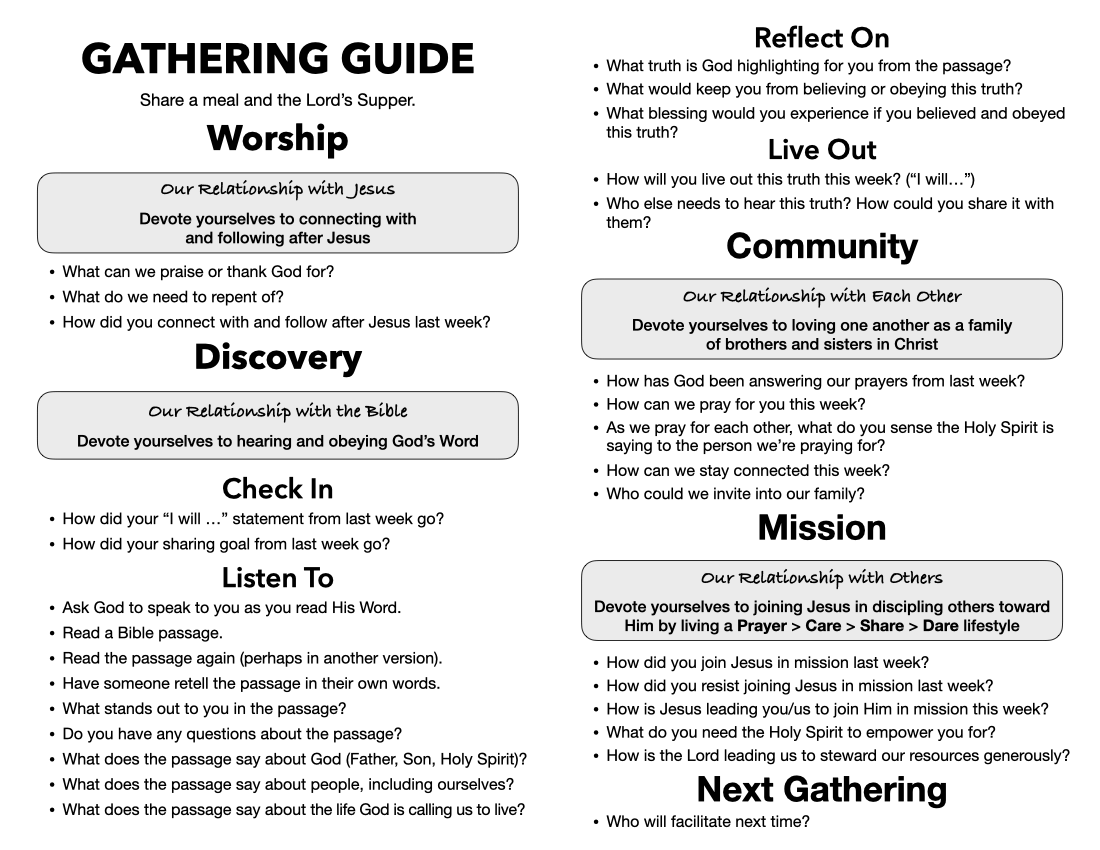
So let’s regularly ask each other this question: What do you need the Holy Spirit to empower you for? And let’s lay hands on each other praying for the Holy Spirit power to come upon us. (See the Gathering Guide.)
The Continuing Ministry of Jesus
As the body of Christ, the church carries on the Kingdom ministry of Jesus empowered by the Holy Spirit.
As Randy Fisk writes in The Presence, Power and Heart of God:
Instead of one person, Jesus—speaking His powerful words and doing His awesome works—suddenly Jesus begins to act via the Holy Spirit through every believer. This initiates what has to be one of the devil’s worst nightmares: instead of one Jesus at work, there are now millions and millions of “Jesuses” walking around, doing what He did!
Let’s give the devil bad dreams.