

Practicing the Prophetic
God speaks primarily through His Word—the Bible. So if you want a word from the Lord, read your Bible.
But as you read your Bible, you will discover that God also speaks to us by His Spirit through a still, small voice, dreams and visions, angels, and the gifts of prophecy, tongues, and interpretation. So how can we grow in practicing and testing prophetic words? Let’s take a look.
Passages on the Prophetic
Acts 2:17-18 quoting Joel 2:28-29 (NIV)
17 In the last days, God says,
I will pour out my Spirit on all people.
Your sons and daughters will prophesy,
your young men will see visions,
your old men will dream dreams.
18 Even on my servants, both men and women,
I will pour out my Spirit in those days,
and they will prophesy.1 Corinthians 14:1-3
1 Pursue love, and earnestly desire the spiritual gifts, especially that you may prophesy. 2 For one who speaks in a tongue speaks not to people but to God; for no one understands him, but he utters mysteries in the Spirit. 3 On the other hand, the one who prophesies speaks to people for their upbuilding, encouragement and comfort.
1 Corinthians 14:26
What should you do then, brothers and sisters? When you come together, each one has a song, has a lesson, has a revelation, has a tongue, has an interpretation. Let all these be done to build each other up.
1 Corinthians 14:29 (NLT)
Let two or three people prophesy, and let the others evaluate what is said.
1 Thessalonians 5:19-22 (NIV-1984)
19 Do not put out the Spirit's fire; 20 do not treat prophecies with contempt. 21 Test everything. Hold on to the good. 22 Avoid every kind of evil.
Practicing the Prophetic
Take turns focusing on one person. Ask the Lord how He would build up, encourage, and comfort them (1 Corinthians 14:3). This question may help you get started: “What do you sense the Holy Spirit is saying to the person we’re praying for?” Then sit quietly and listen. You may receive a thought, picture, passage, or even a physical sensation (such as pain in your body).
When sharing, avoid overly authoritative language like “Thus says the Lord.” Instead, offer impressions humbly and invite discernment. For example: “I had a thought/picture/passage/pain that might be from the Lord. Does this resonate with you? What do the rest of you think?”
If nothing comes, that’s okay—prayerful listening is part of learning. Don’t force it. Remember, faith is spelled T-R-Y.
If something comes to mind, share it—not to impress others, but to love well and build others up.
When something is shared, it’s important to test it. As a community, be an equal-opportunity tester—you can’t invite discernment for one person’s word and not another’s. It’s wise to weigh all impressions together.
Some words carry more weight than others. Simple encouragements can be received and briefly assessed, but words that give direction or call for significant life change require careful and prayerful testing.
How?
Testing the Prophetic
Use this 3C Test for prophetic words, interpretations of tongues, or any leading you sense from the Spirit.
1. Consistent
Is this “word” consistent with the Word?
The Written Word — the Bible
A prophetic impression doesn’t need to quote a verse directly, but it must align with the overall teaching and character of Scripture. Any word that doesn’t pass this test must be rejected.
The Living Word — Jesus Christ
Is this something Jesus would say—and would He say it this way?
2. Constructive
Is this “word” constructive for the person?
Upbuilding
Prophetic words are given for the upbuilding, encouragement and comfort of others (1 Corinthians 14:3). In other words, the purpose of prophecy is to strengthen people.
This doesn’t mean the Spirit won’t give a word of correction to you or through you for someone else. But such words must be handled with great care. Satan condemns; the Spirit lovingly convicts. So be sure to share correction in a constructive way—building up, not tearing down.
If you’re unsure how to share a corrective word, confidentially seek wisdom from a trusted brother or sister.
The Fruit of the Spirit
Do you see the fruit of the Spirit in both the content of this word and the manner in which it is shared?
3. Confirmed
Is this “word” confirmed by the body?
Testing
Invite others to help discern whether a prophetic word is from the Lord. Especially when a word involves significant decisions or life changes, seek wisdom from mature believers and allow time for confirmation.
Testing a word isn’t unbelief—it’s obedience. God commands us to let others evaluate what is said (1 Corinthians 14:29) and to test everything (1 Thessalonians 5:21).
Quoting Deuteronomy 19:15, Paul writes: On the testimony of two or three witnesses every matter shall be confirmed (2 Corinthians 13:1).
Receiving and Rejecting
If a prophetic word is confirmed, you can move forward with confidence. If it is not confirmed, hold it loosely and wait—confirmation may come.
Conclusion
If a “word” proves consistent with God’s Word, constructive for the person, and confirmed by the body, you can be confident it is from the Lord. If it doesn’t pass these tests, you can be sure it is not.
Practicing and Testing the Prophetic Bookmark
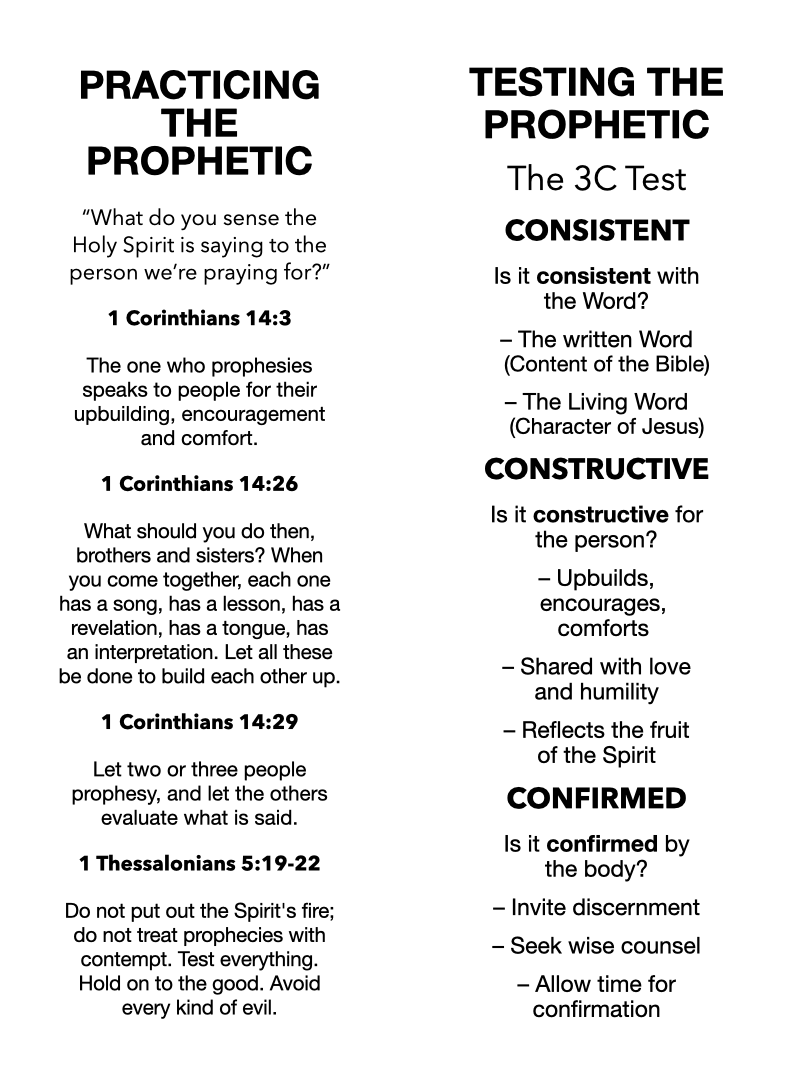
For how to use spiritual gifts, prophecy and tongues in community, see Lead The Way - SPIRITUAL GIFTS, PROPHECY AND TONGUES.