

LEAD THE WAY
The Core
4. DISCOVERY
CONNECT
Connect through care, prayer and loving accountability for previous “I will …” statements
DISCOVER
WHY DISCOVERY?
Some fruitful MicroChurch movements organize their approach around three priorities: Worship, Community and Mission.
We felt it was important to add Discovery to highlight our relationship with God’s Word. After all, it’s through the Bible that we learn how to worship Jesus and discern His will for our community and mission.
We intentionally chose the word Discovery over preaching, teaching and even study. MicroChurches aren’t simply smaller gatherings centered around a preacher or teacher, nor are they typical small-group Bible studies. Instead, we use a Discovery Bible Study method that encourages everyone to engage with God’s Word, hear from Him, and take ownership of how they respond.
Let’s learn about the WHY and HOW of doing a Discovery Bible Study.

DISCOVERY - Our Relationship with the Bible
Devote yourselves to hearing and obeying God’s Word
Work through Be The Way - Discovery (now or previously).
The Discovery Sequence
How do you see the following Discovery Sequence in relation to God’s Word (which includes Jesus’ words, of course) in Luke 6:46-49?
To HEAR the Word - KNOWLEDGE
To OBEY the Word - FAITH
To EXPERIENCE the Word - BLESSING
To SHARE the Word - WITNESS
Luke 6:46-49 (NLT)
46 So why do you keep calling me ‘Lord, Lord!’ when you don’t do what I say? 47 I will show you what it’s like when someone comes to me, listens to my teaching, and then follows it. 48 It is like a person building a house who digs deep and lays the foundation on solid rock. When the floodwaters rise and break against that house, it stands firm because it is well built. 49 But anyone who hears and doesn’t obey is like a person who builds a house right on the ground, without a foundation. When the floods sweep down against that house, it will collapse into a heap of ruins.
Why does each component of this Discovery Sequence build on each other?
What components of the Discovery Sequence does James highlight in James 1:22-25?
James 1:22-25 (NLT)
22 But don’t just listen to God’s word. You must do what it says. Otherwise, you are only fooling yourselves. 23 For if you listen to the word and don’t obey, it is like glancing at your face in a mirror. 24 You see yourself, walk away, and forget what you look like. 25 But if you look carefully into the perfect law that sets you free, and if you do what it says and don’t forget what you heard, then God will bless you for doing it.
Why are obedience and faith linked together in James 2:14-26?
James 2:14-26 (NIV)
14 What good is it, my brothers and sisters, if someone claims to have faith but has no deeds? Can such faith save them? 15 Suppose a brother or a sister is without clothes and daily food. 16 If one of you says to them, “Go in peace; keep warm and well fed,” but does nothing about their physical needs, what good is it? 17 In the same way, faith by itself, if it is not accompanied by action, is dead.
18 But someone will say, “You have faith; I have deeds.”
Show me your faith without deeds, and I will show you my faith by my deeds. 19 You believe that there is one God. Good! Even the demons believe that—and shudder.
20 You foolish person, do you want evidence that faith without deeds is useless? 21 Was not our father Abraham considered righteous for what he did when he offered his son Isaac on the altar? 22 You see that his faith and his actions were working together, and his faith was made complete by what he did. 23 And the scripture was fulfilled that says, “Abraham believed God, and it was credited to him as righteousness,” and he was called God’s friend. 24 You see that a person is considered righteous by what they do and not by faith alone.
25 In the same way, was not even Rahab the prostitute considered righteous for what she did when she gave lodging to the spies and sent them off in a different direction? 26 As the body without the spirit is dead, so faith without deeds is dead.
How is obedience faith in action?
What happens if you HEAR the Word but do not OBEY it? Will you EXPERIENCE the blessing of the Word—its truth, promise, and transforming power in your life?
What happens if you move directly from HEARING to SHARING—skipping OBEYING and EXPERIENCING the Word? Will your witness carry credibility and conviction?
What’s the difference between IMMATURE “growth” and MATURE growth in the Discovery Sequence?
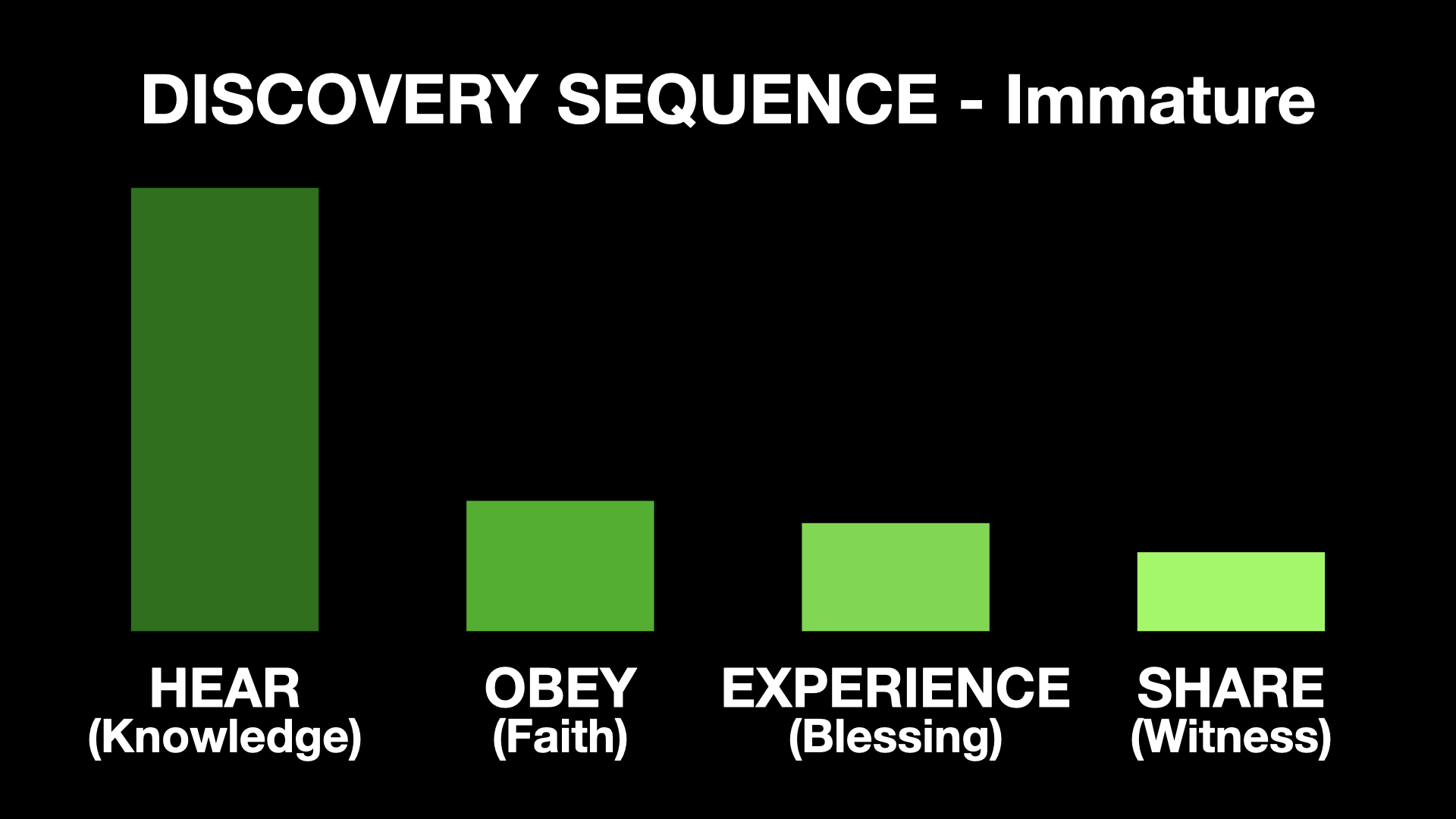
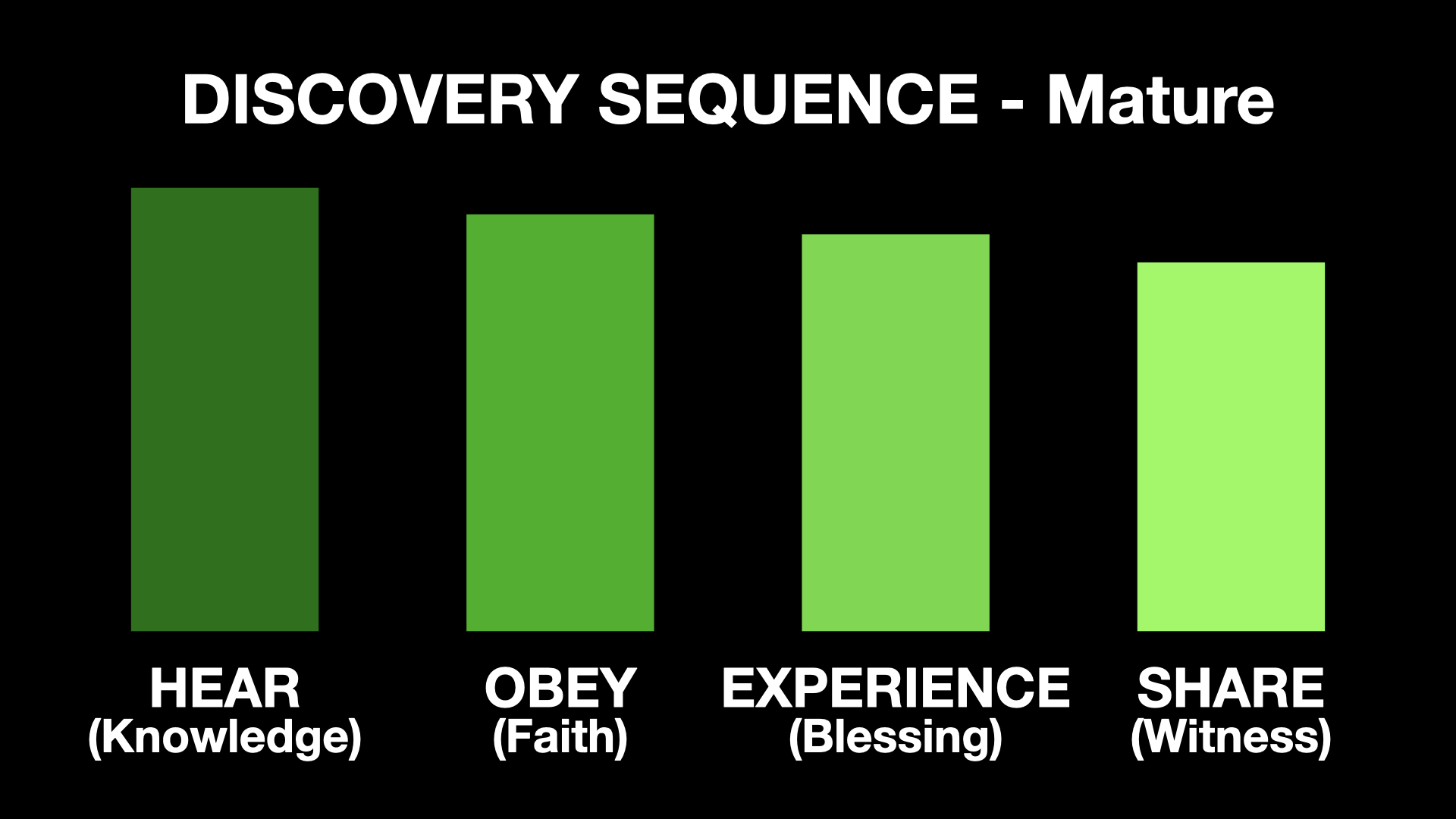
For a mature follower of Jesus to HEAR is to OBEY. And personal EXPERIENCE of the truth, power and promises of Jesus’ words brings credibility and conviction when we SHARE them with others.
To Hear Is To Obey
To Obey Is To Experience
To Experience Is To Share
Why are MicroChurches uniquely able to help people mature in this Discovery Sequence?
How do the following DISCOVERY BIBLE STUDY questions encourage mature growth in this Discovery Sequence?
DISCOVERY BIBLE STUDY
From the Gathering Guide
Check In
How did your “I will …” statement from last week go?
How did your sharing goal from last week go?
Listen To
Ask God to speak to you as you read His Word.
Read a Bible passage.
Read the passage again (perhaps in another version).
Have someone retell the passage in their own words.
What stands out to you in the passage?
Do you have any questions about the passage?
What does the passage say about God (Father, Son, Holy Spirit)?
What does the passage say about people, including ourselves?
What does the passage say about the life God is calling us to live?
Reflect On
What truth is God highlighting for you from the passage?
What would keep you from believing or obeying this truth?
What blessing would you experience if you believed and obeyed this truth?
Live Out
How will you live this truth out this week? (“I will …”)
Who needs to hear this truth? How will you share it?
What is the significance of each component of the Discovery Bible Study?
How has this format for Bible study helped you?
What are its advantages and disadvantages?
Why does a Discovery Bible Study promote engagement in the process and the ownership of outcomes?
Why is a group Discovery Bible Study an ideal way to teach individuals how to feed themselves as they read Scripture on their own?
Sometimes to get a good Discovery Bible Study going all you need to do is ask the first Listen To question: “What stands out to you in this passage?” It sort of takes off from there. It still is good though to ask the final three Listen To questions to summarize your discussion:
What does the passage say about God (Father, Son, Holy Spirit)?
What does the passage say about people, including ourselves?
What does the passage say about the life God is calling us to live?
Prepare
Read and pray through the passage several times during the week.
You could consult the NIV Study Bible or the Life Application Study Bible.
You could consult with a commentary like Enduring Bible Commentary.
You could consult the Serendipity Bible for Groups for additional questions to ask.
The goal is not to teach but to lead to personal and group discovery through leading questions.
If at all possible use questions to teach. For example, if the passage you are studying has Pharisees and Sadducees at odds with each other, you may want to clarify the distinction between them. However, don’t just teach on this. Instead, first ask if someone knows the difference between the Pharisees and Sadducees? Give others as many opportunities to engage in the discussion. If no one knows the difference, spend some time highlighting the differences and then get right back into the discussion of the passage. Obviously, we shouldn’t teach to show off our knowledge but to help the family encounter the truth of God’s Word.
There may be times when you need to put your teacher’s-hat on to explain something, but those should be few and far between. Put your discovery-facilitator-hat back on as quickly as possible by asking more questions.
The key is to ask good questions. In fact, in true rabbinical style answer questions with questions. “Good question Tom. What do you think? Or what do others think?’’
Good questions lead to
Good discussions lead to
Good discoveries lead to …
For additional help in interpreting the Bible see the extra session on Discover called Hermeneutics.
Lead
Don’t be afraid to lead your group at the weekly gatherings.
Direct, but don’t dominate. Don’t monopolize the conversation.
Your role isn’t to teach, but to ask good questions, to direct your group to God’s Word and to actively listen to their responses and the Spirit’s leading.
LEAD BY ASKING NOT BY TELLING.
BE THE WAY combines Bible readings and discovery questions. Use the questions provided, rewording them and adding follow-up questions as needed.
Note rabbit trails and pull your group back to the main path.
Here are some simple guidelines for your group:
Everyone gets to participate
No one gets to dominate
What’s shared here stays here
What's learned here leaves here
When someone shares something sensitive, remind the group of the value of confidentiality.
It’s important for you to quickly get on top of someone who is dominating the gathering. And it’s not hard to do. Just break in and say, “Thanks for that, Sue. Juan, what do you think?”
If Sue continues to dominate, the next time you ask a question, don’t leave any space for her to chime in. Direct the next question to someone else. “Nigel, how would you answer our next question?”
Nothing will kill your gathering like a domineering person. So be direct and protect your group.
1 Corinthians 14:26
What should you do then, brothers and sisters? When you come together, each one has a psalm, has a teaching, has a revelation, has a tongue, has an interpretation. Let all these be done to build each other up.
Colossians 3:16 (NET)
Let the word of Christ dwell in you (plural) richly, teaching and exhorting one another with all wisdom, singing psalms, hymns, and spiritual songs, all with grace in your hearts to God.
Chip Holmes in HOUSE CHURCH: Ancient Model / Modern Stats
[The] church was never intended to be a spectator sport. It is everyone bringing their gifts to a small group of believers and using them to build one another up. This does not discount leadership; it just makes leaders equippers instead of lecturers. They should be orchestrating the meeting to ensure order and orthodoxy. This also allows members to use their gifts beyond service and mercy, thus fulfilling their call.
When leading your MicroChurch, think of yourself as a band or orchestra director. You’re not making the music all by yourself. You’re bringing out the music from the family. So to speak, all you have is a conductor baton. They’re the ones with the instruments. Of course, you’re going to participate in the conversation as well. But work hard at drawing others into that conversation.
Correct
What do you do when someone answers a question in a way that is clearly wrong or headed in the wrong direction?
For example, someone may say, “When Jesus said, ‘The poor you will always have with you, but you will not always have me’ (Matthew 26:11; Mark 14:7; John 12:8), He was saying that the church doesn’t need to care for the poor.”
Here’s a possible way to handle it: “Okay, Tom, thanks for that. What about the others? Do you think that’s what this passage is saying? And can you think of other passages that might speak to this?”
This is a good opportunity to let Scripture interpret Scripture. Point out that the footnote in this passage indicates that Jesus is quoting from Deuteronomy 15:11. Have someone look it up and read it.
There will always be poor people in the land. Therefore I command you to be openhanded toward your fellow Israelites who are poor and needy in your land.
That certainly sheds some light on what Jesus meant. Another passage someone may bring up—or you could bring up if necessary—is Galatians 2:9–10, where Paul says that James, Cephas, and John asked him and Barnabas to continue to remember the poor.
Here are the priorities:
Get back to the Bible. Ask, “What does this passage say, and what do other passages say?” Let Scripture interpret Scripture.
Draw in others to help correct the person and the thought.
If no one else is quite getting it, this is where you can step in and show how the passage and other passages speak to the issue.
The point is you’re not there to win an argument, but to guide your group in biblical truth and obedient living. Besides, how you handle someone who is clearly going in the wrong direction will model to the others how they can do the same when they get into their own discipling relationships.
Bottom line: Be prepared for this sort of thing to happen. It will. So ask God to guide you. He will. And keep in mind, some of the best breakthroughs happen when there is some tension to push through.
Discovery and Kids
Depending on the age and maturity of the children, they may be able to join in our your Discovery Bible Study. Some MicroChurches may want to have a separate Discovery Bible Study for the children. You could have them study the same passage that the adults are or you may want to find a children’s Bible study curriculum designed just for them. Here are some to consider:
LIVE / LEAD
What did you discover in this training session?
What is your “I will …” statement flowing from this training?
If you’re working through BE THE WAY as a group, who will facilitate the next session on Community?
Extra Session on Discovery
PRINTABLE PDF
LEAD THE WAY
The Core
Continuing Ed
Praying Paul’s Prayers (Lead)
Replicate (Lead)
Disciple-Making Movements (MicroChurch)
Financial Giving (MicroChurch)
Our Meal and His Supper (Worship)
Baptism (Worship)
Hermeneutics (Discovery)
Mature Community (Community)
Child and Youth Safety (Community)
Welcoming New People (Community)
Spiritual Gifts, Prophecy and Tongues (Community)
Doing the Stuff - 1 (Mission-Part 1)
Doing the Stuff - 2 (Mission-Part 1)
Doing the Stuff - 3 (Mission-Part 1)
A Guide for Guides (Mission-Part 2)